

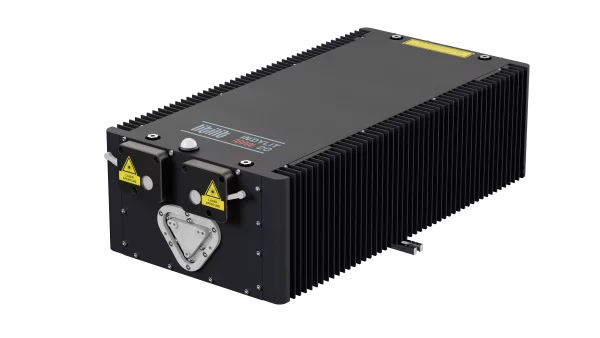
Femtosecond lasers
INDYLIT 20
Industrial Femtosecond Laser for Material Processing
The Indylit 20 is the highest average power and most efficient passively air-cooled femtosecond laser on the market. If you need a reliable femtosecond laser that is maintenance-free, turn-key and has exquisite optical parameters – look no further! The laser features an innovative and patented passive cooling design, ensuring high stability of the optical parameters such as pulse duration, beam pointing, and power. Indylit 20 mechanical construction can withstand almost everything you can throw at it. It is even protected against the dust! Built-in optional second harmonics (SH) module provides wavelength extension enabling even wider range of material processing applications.
- Wavelength
- 1030/515 nm
- Pulse duration
- 400 fs – 4 ps
- Average power
- 20 W
- Repetition rate
- 80 kHz – 1.0 MHz

Key features

Adjustable repetition rate, pulse duration, power

High pulse energy and clean pulse shape

Passively air cooled (water cooling optional)

Maintenance-free & turn-key

Protected against dust
Technical Specifications
Full specification from the INDYLIT 20 datasheet. Measurement conditions and patents are in the Notes tab.
- Central wavelength
-
Indylit 20 1030 ± 2 nm
Indylit 20 SH 515 ± 1 nm (optional) - Average power 1)
-
Indylit 20 > 16 W @ 80 kHz / > 18 W @ 200 kHz / > 20 W @ 1 MHz
Indylit 20 SH > 10 W @ 80 kHz / > 10 W @ 200 kHz / > 5 W @ 1 MHz - Max. pulse energy 1)
-
Indylit 20 > 200 μJ
Indylit 20 SH > 120 μJ - Pulse duration
-
Indylit 20 380 ± 20 fs
Indylit 20 SH 350 ± 50 fs - Pulse duration tunability 2)
-
Indylit 20 400 fs – 4 ps
Indylit 20 SH 400 fs – 3 ps3) - Switch time between harmonic outputs
- < 1 s
- Internal pulse repetition rate
-
80 kHz – 1.0 MHz
down to 30 kHz in Burst Mode - Pulse picker
- Integrated
- Pulse control mode
- Pulse picker control via TTL signal (gate or trigger mode)
- Pulse on demand
- Yes (optional), jitter <50 ns
- Burst length
- 1...12 pulses
- Intra-burst pulse distance
- 50 ns
- Burst shape control
- Freeform, via Analog Input
- Max. energy in burst
-
Indylit 20 > 600 μJ at 30 kHz
Indylit 20 SH > 300 μJ at 30 kHz - Power attenuation 3)
- 100 – 1%
- Beam quality
- M² < 1.2
- Beam circularity (astigmatism) 4)
-
Indylit 20 > 0.90
Indylit 20 SH > 0.85 - Beam diameter (at 1/e² level)
-
Indylit 20 2.6 ± 0.2 mm
Indylit 20 SH 2.2 ± 0.2 mm - Polarization
- Linear horizontal, > 1000:1 extinction
- Pre-pulse contrast
- > 1:500
- Post-pulse contrast
- > 1:100
- Beam divergence (full angle)
- < 1 mrad
- Beam pointing (RMS) 5)
- < 20 μrad
- Beam pointing vs temp.
- < 20 μrad/°C
- Power Stability (RMS) 6)
-
Indylit 20 < 0.5%
Indylit 20 SH < 1% - Pulse Energy Stability (RMS) 7)
- < 1%
- Warm-up time (cold start)
- < 30 min
- Warm-up time (warm start)
- < 5 min
- Laser control interface
- CAN, USB
- Operating voltage
- 24VDC, 25A (100...240 V AC, 47...63 Hz to 24V AC/DC converter included)
- Average power consumption (after warm-up)
- 300 W
- Maximal power rating
- 700 W
- Operating temperature
- 18 – 33 °C
- Humidity
- Non-condensing
- Transportation/storage temperature
- -20 – +70 °C
- Dimensions – Laser head (L x W x H)
- 482 x 248 x 143 mm
- Dimensions – Control unit (L x W x H)
- 449 x 370 x 140 mm
- Dimensions – AC/DC converter (L x W x H)
- 250 x 125 x 60 mm
- Umbilical length
- 5.5 ± 0.1 m
- Cooling – Laser head
- air (passive) or water coldplate (optional) 8)
- Cooling – Control unit
- forced air (fans)
1) Please refer to the power and energy vs. pulse repetition rate curves for typical values. Switching time between different repetition rates and burst number is <20ms.
2) 1030 power is constant at all pulse durations; 515nm power is guaranteed only at min pulse duration and will decrease when stretching the pulse duration.
3) Attenuation can be controlled by a few different methods: a) by PC user interface, b) by CAN register, c) by analog input (0-1V, rise time <1μs). Beam quality specifications are maintained down to 10% power level for 1030nm output and 3% for 515nm output.
4) Defined as the worst case ellipticity along the z-scan (± 5 × LRayleigh) of the beam.
5) Measured during 8 h operation starting 30 minutes after warm-up. Environmental temperature stability within ± 1 °C.
6) Measured with integration time of 1 s at the same conditions as (5).
7) Measured within 10 s time interval for at least 1000 pulses.
8) Coldplate is provided attached to the laser head of the laser. A water chiller is not provided. Requirements for the chiller are >1L/min flow rate and 25-33 °C water temperature.
9) Technology is protected by international patents: LT6261 (B); JP6276471 (B2); US10038297 (B2); EP3178137; DK3178137 (T3); CN106575849 (B); PL3178137 (T3); LT6639 (B); LT2020 563. For details please contact Litilit.
Applications
Materials microprocessing
Ophthalmology
Semiconductor and electronics
Display manufacturing
Battery manufacturing
Black marking
Where INDYLIT 20 is used
Each application page walks through the problem, the process and the results.
All applications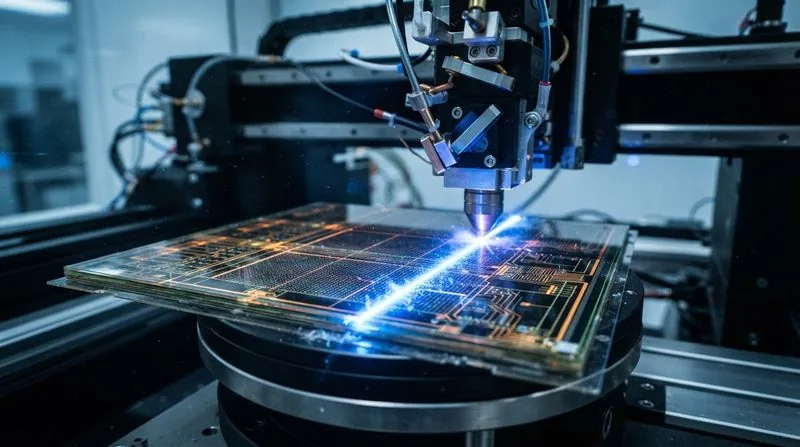
Display and glass processing
Cutting and scribing thin glass, and the through-glass vias that glass substrates need.
Black marking
Corrosion-resistant black marking on stainless steel and other metals.
Semiconductor and electronics
Dicing, grooving and drilling of thin wafers and brittle materials.
Integration resources

INDYLIT 20 datasheet
Full PDF datasheet with performance curves, beam profiles, drawings and electrical specifications.

Dimensions and drawings
Laser head 482 x 248 x 143 mm, control unit 449 x 370 x 140 mm. Dimensional drawings are in the datasheet.
Support and dealers
Integration questions, service and your regional contact.
Full lineup
Which system is right for you?
Every Litilit laser is built on the same robust fiber platform. Choose the model that best matches your pulse duration, power, and repetition rate requirements.
| Specification | INDYLIT 20 Industrial Femtosecond Laser for Material Processing Selected | INDYLIT 10 Industrial Femtosecond Laser for Industrial and Medical Applications | INDYLIT 3 Ultracompact Femtosecond Laser for Ophthalmology |
|---|---|---|---|
| Wavelength | 1030/515 nm | 1030 nm | 1030 nm |
| Pulse Duration | 400 fs – 4 ps | 400 fs – 4 ps | 290 fs |
| Average Power | 20 W | 10 W | 2.5 W |
| Repetition Rate | 80 kHz – 1.0 MHz | 80 kHz – 1.6 MHz | 1–3 MHz |
| Primary Applications | Materials microprocessing, Ophthalmology, Semiconductor and electronics | Materials microprocessing, Ophthalmology, Semiconductor and electronics | Ophthalmology, Photopolymerization, Semiconductor and electronics |
| Request Quote | View INDYLIT 10 | View INDYLIT 3 |

Not sure which system fits your application?
Our application engineers are ready to help you benchmark, simulate, and configure the ideal pulse parameters and laser integration setup for your specific industrial or clinical requirements.
Discuss your application with an engineer.
Tell us the material and the result you need. A laser engineer replies within [response time].
Buying for production?
Ask about lead times, volume pricing, supply capacity and long-term availability.
Request a quote